Performance Optimization

A faster Adobe Commerce store, guaranteed — or you don’t pay.

We diagnose and fix the server performance of your Adobe Commerce site, and we put the Time to First Byte target in the contract. Miss it, and the implementation phase is free.

  • Since 2015 On Magento and Adobe Commerce

  • 60+ In-house Magento 2 extensions

  • 6 Senior engineers, small by design

Our guarantee

A measurable TTFB improvement, or you don’t pay.

We set a Time to First Byte target at kickoff. If 28-day CrUX field data doesn’t show it by the end of the engagement, you owe nothing for the implementation phase.

Core Web Vitals

The four numbers we move.

Core Web Vitals are field data from real shoppers, and Google ranks on them. We treat them as targets, and every engagement ships with before-and-after CrUX readings.

LCP

≤ 2.5 seconds

When the hero or product image is fully drawn. The best proxy for “has the page loaded?”

  • Good ≤ 2.5s

  • Needs work

  • Poor > 4s

INP

≤ 200 milliseconds

The slowest tap or click a shopper hits all session. Add-to-cart, mini-cart and filters live here.

  • Good ≤ 200ms

  • Needs work

  • Poor > 500ms

CLS

≤ 0.1 score

How much the page jumps while loading. Reserved space for galleries and banners fixes it.

  • Good ≤ 0.1

  • Needs work

  • Poor > 0.25

TTFB

≤ 800 milliseconds

The server’s number. On Adobe Commerce it drags everything else down, and it’s the one we guarantee.

  • Good ≤ 0.8s

  • Needs work

  • Poor > 1.8s

Time to First Byte

Fix TTFB and the rest follows.

Time to First Byte is the gap between the request and the first byte of HTML. On Adobe Commerce that gap is where unindexed queries, layered navigation, third-party modules and missed full-page cache hits pile up.

We go after all of it: PHP-FPM, OPcache, Redis, Varnish hit rate, indexers, OpenSearch, MySQL slow queries and CDN origin shielding.

A typical Adobe Commerce page load

  • PHP, DB, cache, CDN
  • HTML, CSS, hero image
  • JS hydration, listeners

Cutting 400ms of TTFB on a category page typically pulls LCP down 300–500ms in field data, with no front-end change.

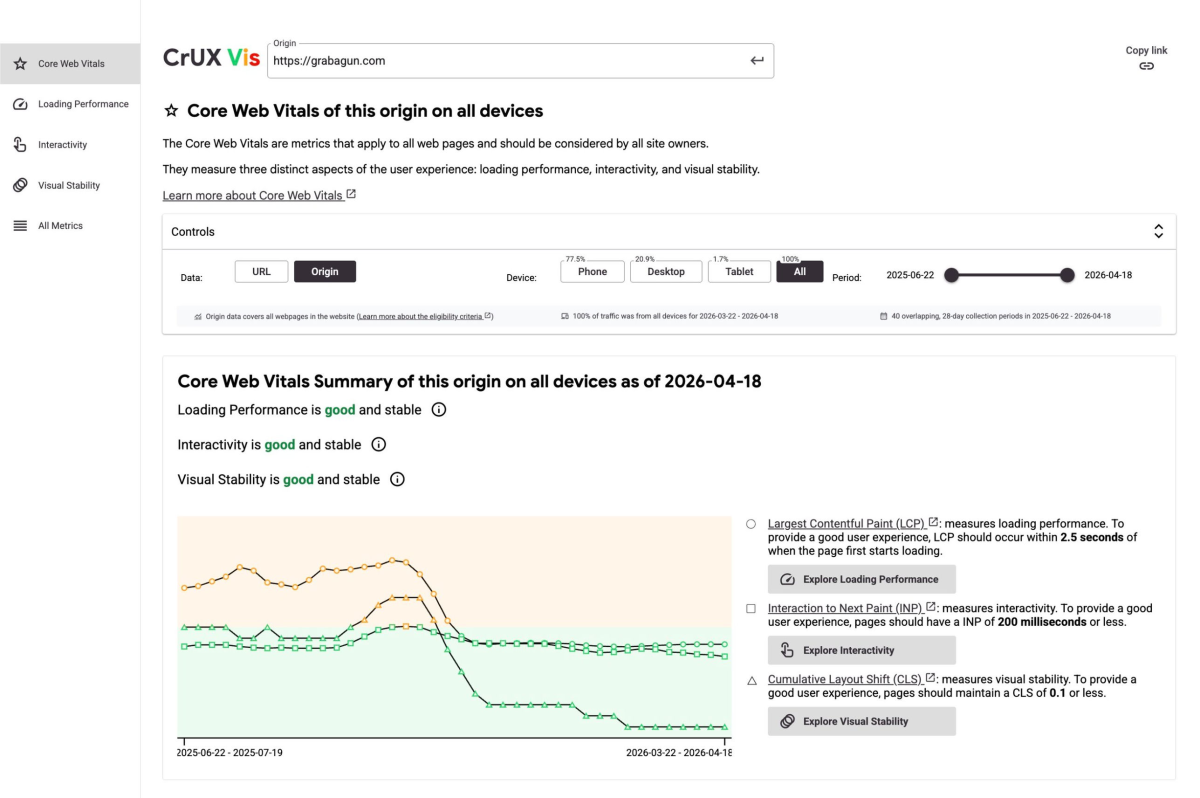
CrUX Vis dashboard showing Core Web Vitals trending from poor to good over a ten-month engagement.
CrUX Vis · grabagun.com · 28-day rolling field data. Loading, interactivity and visual stability all good and stable.

What good looks like

Real field data, before and after.

Chrome User Experience Report data for a client store. Orange is poor, green is good. The drop is where the work landed.

  • LCP under 2.5s for the full 28-day window

  • INP under 200ms on phone, desktop and tablet

  • CLS under 0.1 on product and category pages

The guarantee

Hit the TTFB target, or the implementation phase is free.

The target goes into the SOW after diagnosis and is validated against 28-day CrUX data. We guarantee TTFB because it’s the number we control end to end: PHP, Varnish, Redis, search and MySQL.

The package

Three phases, scoped to your store.

No fixed audit checklist. We diagnose your codebase, your third-party modules and your CrUX history, then commit to targets in writing before we fix anything.

Phase 01

Diagnose

Two weeks reading the site against field data, lab data and the code. You get a written report with prioritized findings and committed targets.

  • CrUX baseline across LCP, INP, CLS and TTFB

  • Lab profiling on product, category, cart and checkout

  • Module-by-module audit of third-party extensions

Phase 02

Fix

Senior engineers ship the fixes as pull requests to your repo, in your branching model, with tests.

  • Full-page cache tags and Varnish tuning

  • Indexers, MySQL query plans, search sharding

  • Critical CSS, image formats, JavaScript deferral

Phase 03

Certify

We don’t leave until the field data agrees with the lab. Then dashboards and alerting, so the gains hold.

  • 28-day CrUX validation against the targets

  • Real-user monitoring dashboard

  • Performance budgets in CI

Adobe Commerce specifics

What we actually look at.

A generic Web Vitals audit misses the Adobe Commerce-shaped problems. These are the ones we pull apart.

FPC & Varnish

Cache-tag explosion from bad modules, grace and keep tuning, ESI for customer blocks, hit rate per route.

Redis & sessions

Separate cache, session and FPC connections, eviction policy, pipelining for cart operations.

OpenSearch

Index sharding, layered-navigation query cost, swatch aggregation, suggester latency.

MySQL & indexers

Indexer mode, slow-query triage, EAV join cost on product pages, partial reindex strategy.

Front-end build

Bundling, critical-path inlining, KnockoutJS hot paths, mini-cart payload size, font loading.

Third-party modules

Plugin ordering, observer cost, around-plugin overuse, and the usual well-known offenders.

Investment

Projects start at $10,000.

Every project is scoped to your catalog, your module estate and the targets we commit to. Pricing follows a free 30-minute call.

Starting at

$10,000

Diagnosis, prioritized findings and the TTFB target we’re prepared to guarantee on your site.

Backed by the guarantee.Miss the target and the implementation phase is free.

Timeline

Eight to twelve weeks, kickoff to certified.

We work in your repo, your branches and your sprint cadence.

1

Kickoff

Week 0Access, walkthrough, agreed targets.

2

Diagnose

Weeks 1–2Profiling, module audit, written report.

3

Fix

Weeks 3–9Pull requests reviewed by your team, weekly demos.

4

Certify

Weeks 10–1228-day CrUX validation, dashboards, handoff.

We’re not a full-service agency: no UX, SEO or paid search. We’re a development-focused eCommerce agency that partners with your in-house team or marketing agency.

Kraken Commerce · Small by design · Founded 2018

Ready to see what your store could be doing?

Send us your URL and a sentence about what you’re seeing. Within two business days you’ll get a free read of your CrUX data and whether an engagement makes sense.

Your note goes straight to a senior engineer.